
Advice
As I explained before, this diary was predominantly written for myself and my friends. However, I learnt a hell of a lot from my Coast to Coast experience, and it seemed a shame not to put those lessons into writing somewhere. So if you've stumbled onto this site from Google, and you're looking into doing the Coast to Coast yourself, then here's a few bits of advice for your reading pleasure.
Maps: Thanks to the Ordnance Survey, getting maps for the Coast to Coast is far more complicated than it should be. This fantastic website has information on all the options though, as well as a few other bits and pieces that people might find useful. If you decide to take the 8-map option, there are still a few tiny bits of the route that aren't covered (or at least they weren't on our old maps), so we used Get-a-map on the Ordnance Survey website to download the bits we needed. You can download them here.
Accommodation: If you need to book places to stay, be it B&Bs or campsites along the Coast to Coast route, you should take a look at Doreen Whitehead's accommodation guide. It lists where you can stay at each town along the route, what kind of accommodation they offer (B&B, camping barn, bunkhouse, campsite) and a lot more on top. We bought the printed version off the same site to take with us in case we needed to change our plans along the journey. Useful hint: "EM" in the guide stands for evening meal. Took us ages to work that one out.
Sherpa Van: We originally only planned to use Sherpa Van to transport us to and from the start and finishing points of the Coast to Coast, as described on their site here, although we ended up using their door to door baggage moving service as well. All in all, a very useful and friendly company. You could do a lot worse than making sure you know what services they provide and taking some contact details along with you: you might well need to use them. And no, they're not paying me to say that.
Boots: Are your boots comfortable? Unless you can honestly say that they've never caused you any problems, you need to do something about it before you go walking. That could be anything from walking them in, buying some clever insoles, hardening your feet or buying some new ones. If you know your boots make your feet a bit sore whenever you take them out on a short hike, just remember that this time you're going to be wearing them every day for 12 days. It's better to deal with the problem now, rather than after they've ripped holes in your feet. Trust me on this one:
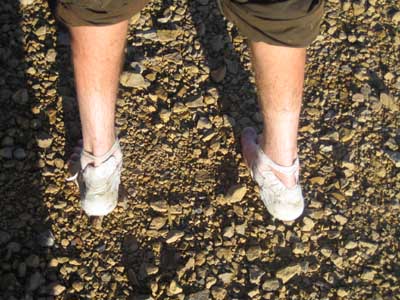
Compeed: A lot of people recommend the Compeed Blister Kits that you can buy. I had some pretty mixed results with them (when they work they're brilliant, when they don't they rip most of your skin off with them), but I think by the end, I'd recommend them too. The key point to remember here though is to stick them on the night before, so they've had time to adhere to your foot before you start walking on them. You don't want a half-stuck Compeed plaster coming off in your boot. Again, trust me on this one:

Flip-flops: In addition to the boots and Compeed advice above, take along some lightweight sandals or flip-flops with you. When you've just taken your boots off after eight hours of walking, you won't want to put them on again to walk to the bathrooms/pub/shop, and it's also quite important to give your feet a bit of time to air each evening.
Trousers: A bit of a subjective one here, but I'd recommend not walking in full length trousers. They'll get very mucky very quickly, and if they're your only trousers for all 12 days, that's not going to be pleasant. Buy some 3/4 length trousers, or better still, buy some trousers with a button tab halfway up the leg so that you can roll them up when you're walking and they won't slowly unroll as you walk.
Money: Cash points are few and far between on the Coast to Coast route, so take along plenty of cash with you. When the pub's switch card policy is the deciding factor in whether you get any dinner that night, you'll wish you had.
Mobile Phones: If keeping in touch with someone back at home is important to you, I'd recommend buying a cheap Orange pay-as-you-go SIM card to take with you. My O2 phone was useless at over half the campsites, Dave's Vodafone mobile wasn't much better, and although our tests with an Orange phone were hardly conclusive, they are supposed to offer more reception around the Coast to Coast route. If anyone reading this knows otherwise, please get in touch and I'll happily retract that statement. Of course, you could always use a payphone, but I wouldn't rely on there being one near each campsite.
That's all the advice I can think of right now. If you are thinking of doing the Coast to Coast, I hope the above helps to put you in good stead for the walk. Good luck.


0 Comments:
Post a Comment